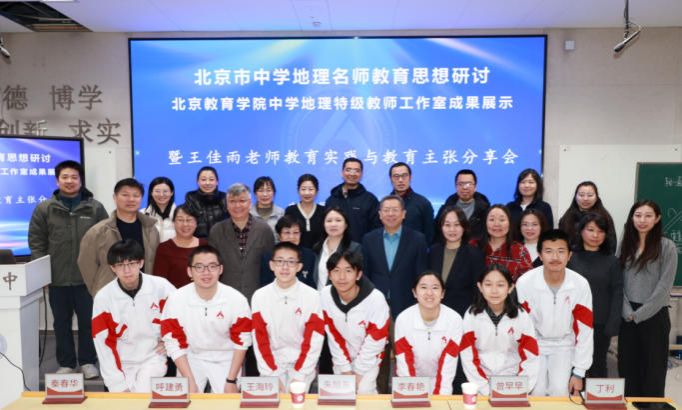
On January 6, 2026, the "Beijing Secondary School Geography Master Teacher Educational Thought Seminar · Beijing Institute of Education Secondary School Geography Special-Grade Teacher Studio Achievement Showcase and Teacher Wang Jiayu's Educational Practice and Educational Approach Sharing Session" was held at RDFZ.
Experts and scholars from Beijing Institute of Education, Beijing Normal University, and Peking University, together with students of Beijing municipal special-grade teacher studios and teacher representatives from RDFZ and the RDFZ Affiliated Schools, gathered to discuss the vivid pathways for front-line teachers to grow through practice, jointly launching an in-depth dialogue on educational innovation and development. The event was presided over by Teacher Zhao Yongchun, Deputy Head of the RDFZ Geography Teaching and Research Group.
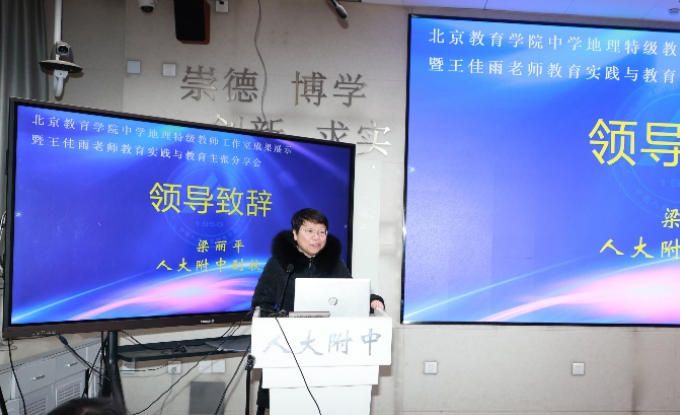
RDFZ Vice-Principal Liang Liping pointed out that Teacher Wang Jiayu, as a backbone teacher of our school, today's sharing session is both a summary of her personal educational practice and a microcosm of RDFZ teachers' professional growth. RDFZ regards teacher development as a core proposition, strives to follow the characteristics and laws of teacher growth, formulates development plans for teachers at different stages, and builds platforms for teacher growth.
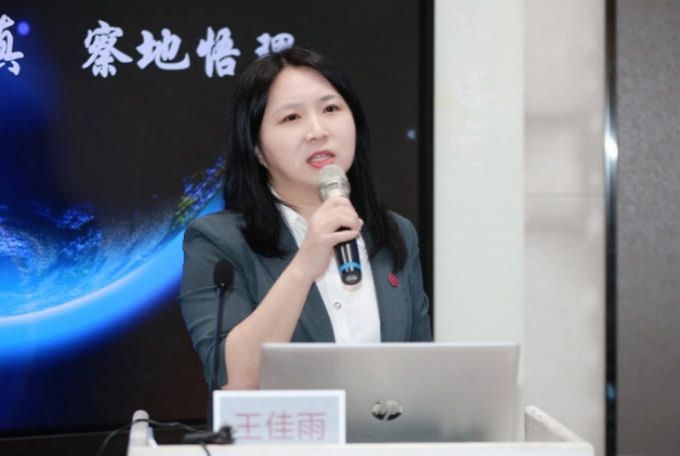
Teacher Wang Jiayu systematically elaborated on her teaching approach of "seeking truth from facts" and "observing the land to comprehend principles" based on her years of teaching practice. She advocates "seeking truth from facts" — moving from classroom practice toward evidence-based research. Starting from students' needs in real learning contexts, she transforms problems in daily teaching into research topics, conducts project research and continuous iteration, and explores forming a "evidence-based" teaching improvement pathway. In practice, she has continuously elevated teaching reflection to academic expression, finding theoretical support in national education policy and the frontiers of academic research, integrating formative assessment, evidence-based education, and other concepts into classroom teaching and examination assessment, and promoting the deep integration of teaching practice and academic research. She also advocates "observing the land to comprehend principles" — cultivating disciplinary values through practice-based education — conducting systematic explorations in the construction of geography practical courses. Through projects such as "Geography Practice Around Beijing," she and her team have built a practical curriculum system deeply aligned with curriculum standards, achieving school-based implementation of the national curriculum, and effectively integrating practical achievements into classroom teaching and examination assessment, continuously improving students' disciplinary competencies.
Teacher Wang Jiayu's sharing unfolded in a gentle, conversational manner: from a student's small request in 2014, to the outstanding achievement of leading Beijing in the inaugural year of the new college entrance examination; from the confusion and frustration of encountering personal setbacks, to the rediscovery of her educational founding mission with the support of leaders, experts, colleagues, and students. To present the best outdoor field practice lessons, she held a handheld gimbal to start live-streaming in the field; to practice her approach of "seeking truth from facts," she accumulated hundreds of thousands of words of interview notes. Her vivid stories and meticulous accounts painted a portrait of a geography teacher's educational journey of "holding the meridians and latitudes, nurturing dreams into light."
In the young backbone teacher representative speech segment, Teachers Liu Jiali and Zhou Yingji, as disciples of Teacher Wang Jiayu, shared their professional development pathways from observing lessons and learning methods, honing exam questions, and participating in projects to forming personal teaching styles under the guidance of their mentor.
Student representatives Wang Yishi, Jiao Boliang, Shi Qingyue, Li Nanxi, Zhong Zikun, and Jiang Xingjian, under the theme of "conveying the charm of true geographic knowledge, exploring the wonders of heaven and earth, cultivating patriotic aspirations to serve the nation, resolving students' individual intellectual puzzles, warming the hearts of students in difficult times, and igniting the fire of youth chasing dreams," told warm stories between teacher and students. They showcased Teacher Wang Jiayu's professional competencies, educational sentiment, and humanistic care, and demonstrated the unique value of geography teaching in fulfilling the fundamental mission of cultivating virtue and nurturing talent.
Teachers Lin Yating and Qi Xiaoran demonstrated two senior high school exam paper review lessons, which were review lessons under the philosophy of evidence-based education. The classroom used problems as the guide, flexibly adjusted teaching methods based on students' actual performance, and provided feedback on teaching. By connecting elements and drawing analogies from one case to others, students were guided to form transferable thinking pathways, embodying the innovative teaching philosophy based on practice.
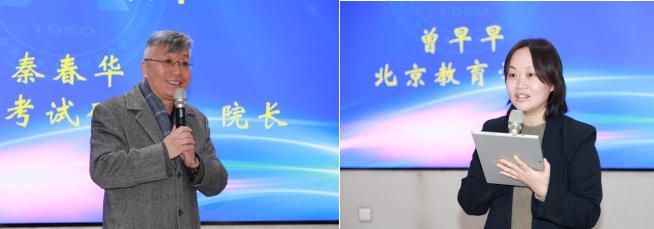
In the multi-perspective professional dialogue segment, Qin Chunhua, Director of the Peking University Research Institute for Examinations, pointed out that Teacher Wang Jiayu practices first and began exploring teaching assessment in 2014, using the concept of "formative assessment" to guide teaching. This echoes national assessment reform policies. In future educational practice, teacher assessment literacy should be further improved to move teaching and assessment reform toward professionalization. Zeng Zaozao, a teacher at Beijing Institute of Education, emphasized that the Beijing municipal geography teacher studio provides solid support for teachers to form their own educational thoughts and approaches. Teacher growth cannot be separated from a deep understanding of the disciplinary essence; teachers should focus on geographical thinking and methods and integrate the essential thinking and methods of the discipline into all aspects of education and teaching.
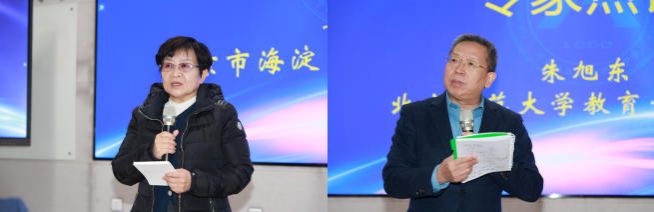
Wang Hailing, former Vice-Principal and geography special-grade teacher of RDFZ, and Principal of Haidian Jinqiu School, proposed that the development of RDFZ's geography teaching and research group over the years can be seen through Teacher Wang Jiayu's growth process. Going forward, front-line teachers should further leverage information technology to promote the intelligentization of teaching assessment, systematically develop geography practical courses, and form a batch of geography teaching practice achievements with innovation and promotional value.
Professor Zhu Xudong, Dean of the Faculty of Education at Beijing Normal University, systematically outlined six key dimensions of teacher professional growth: first, "personal garden building" — teachers should have independent research areas for exploration beyond completing common teaching tasks, forming a self-driven growth awareness; second, "project drive" — drawing on cutting-edge project resources to promote continuous iteration of teaching practice; third, the influence of "significant others" — the guidance and support of mentors and peers in the growth process is indispensable; fourth, "mentoring and passing on" — achieving mutual promotion in the process of guiding young teachers; fifth, "teaching and learning enhance each other" — achieving mutual growth of teacher and students through deeply accompanying students and responding to their growth needs; sixth, "platform showcasing" — achieving self-organization, identity construction, and professional recognition in various seminar and showcase activities.
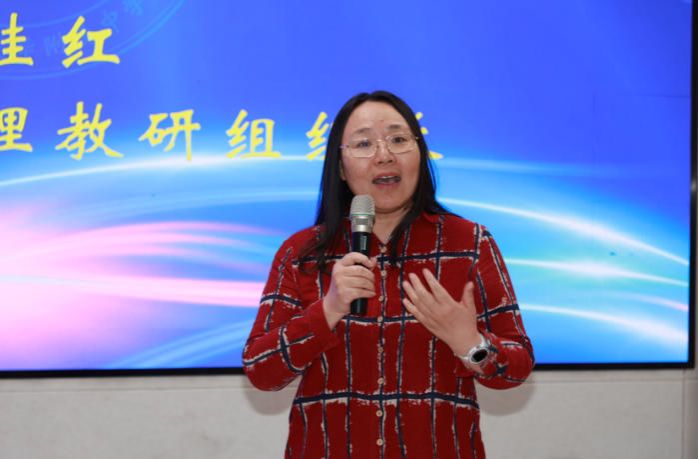
Teacher Yan Guihong, Head of the RDFZ Geography Teaching and Research Group, gave a summary: teacher growth requires both strong internal motivation and team collaboration and expert guidance. In the future, the geography teaching and research group will continue to uphold the teaching and research culture of "progress together, pragmatism, innovation, and research," promoting the coordinated advancement of disciplinary development and teacher professional development. This research activity outlined the growth pathway of a front-line teacher; it is not only a systematic organization of one geography teacher's educational practice, but also a collective reflection on "how to become a good teacher."